Acrylic vs. Modular Courts: Which Court Surface Is Right for You?
Choosing the right surface is one of the most important decisions you’ll make when building a backyard basketball court, pickleball court, or multi-sport game court.
The short answer: Acrylic courts provide the traditional hard-court experience, while a modular court from Sport Court is engineered to address some of the limitations that can come with a conventional hard surface—including impact, water management, and ongoing surface maintenance. For homeowners looking for comfort, durability, customization, and multi-sport versatility, Sport Court offers a compelling alternative to traditional acrylic.
Here’s what you should know when comparing the two.

What Is the Difference Between an Acrylic and Modular Court?
An acrylic court uses layers of acrylic coating applied over a hard base, typically concrete or asphalt. This creates the familiar continuous playing surface found on many traditional outdoor courts.
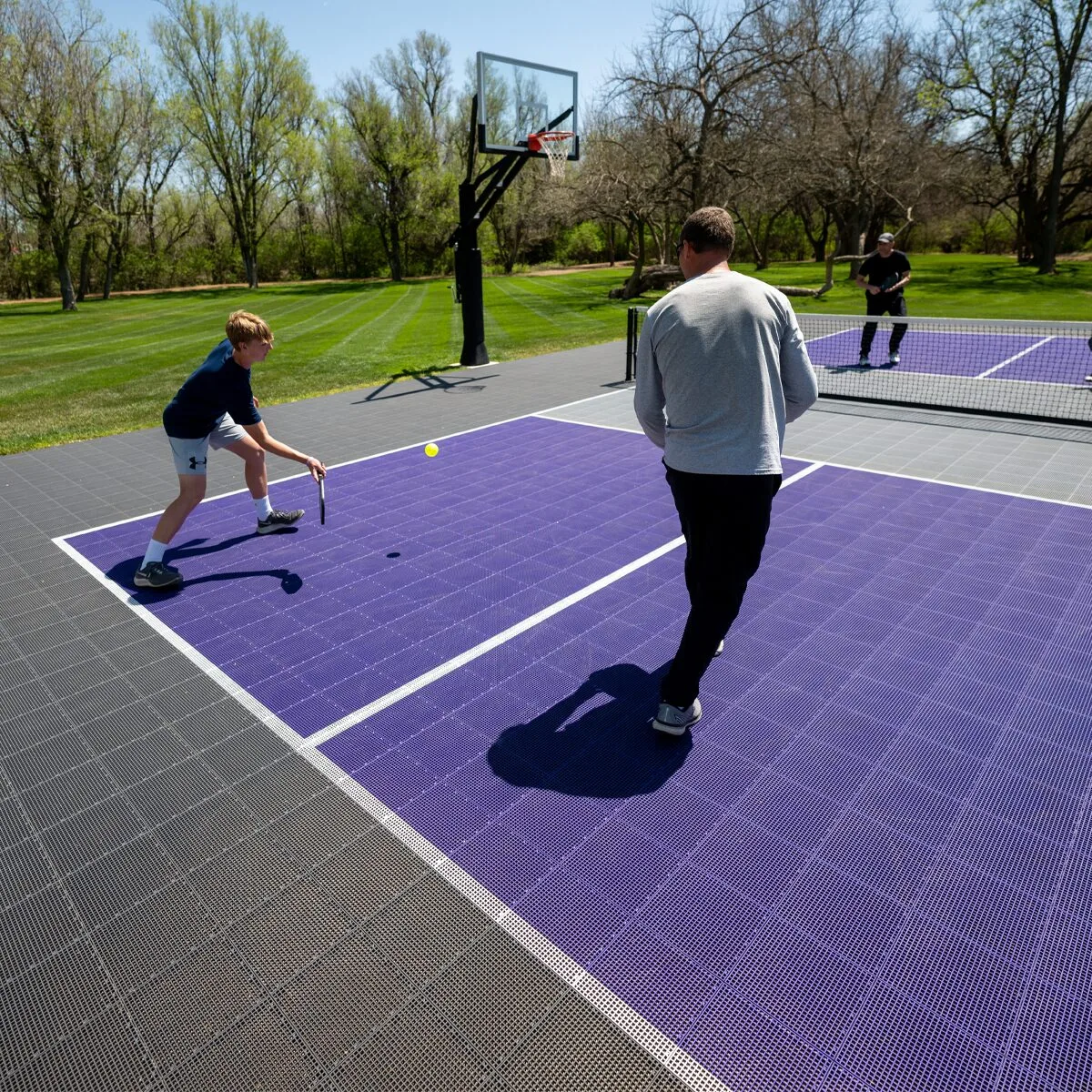
A modular court uses interlocking sport tiles installed over an appropriate base. Rather than relying on a coating applied directly to the concrete to create the finished playing surface, the modular system creates a separate performance layer above it.
It’s a fundamentally different approach to court construction—and that difference can affect everything from how the court handles water to how it feels beneath your feet.
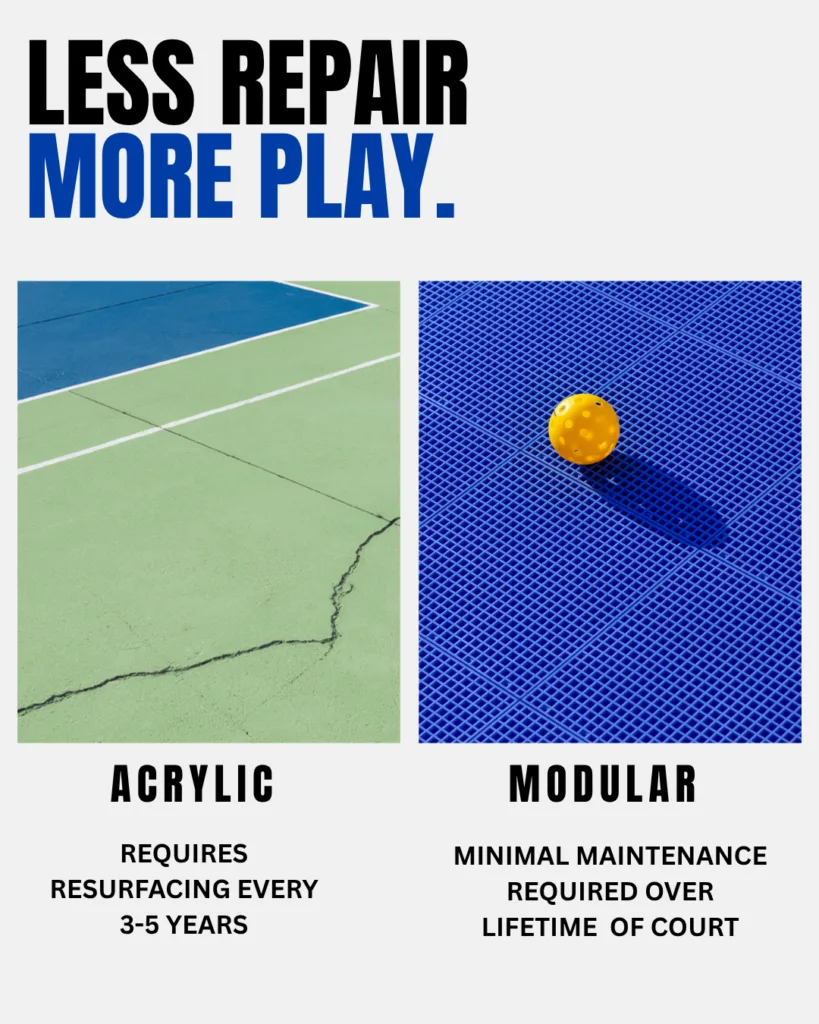
One of the biggest differences between the two surfaces is long-term maintenance.
Acrylic surfaces can require crack repairs, recoating, and resurfacing as the court ages. Because the acrylic surface is applied directly to the base beneath it, deterioration or movement in that base can also become visible through the finished playing surface.
Sport Court modular surfaces are designed with lower surface-maintenance requirements in mind. Routine cleaning is straightforward, and because the playing surface is made up of individual tiles, sections can be addressed individually when necessary.
For homeowners, that can mean less time maintaining the surface and more time playing on it.
Rain is inevitable. How your court handles it can make a big difference in how quickly you can get back outside.
On a solid acrylic surface, water moves across the top of the court toward its drainage points. Low spots or imperfections in the base can allow water to collect and extend drying time.
Sport Court’s open-grid modular design allows water to pass vertically through the playing surface to the base below, helping the playing surface drain and dry efficiently.
That can mean less waiting after the rain and more opportunities to play.
Proper site preparation, grading, and drainage are still important for any outdoor court. A modular surface helps manage water at the playing-surface level, but it doesn’t replace a properly designed base and drainage system.
What’s underneath an athlete matters—especially during sports involving running, jumping, and quick changes of direction.
A traditional acrylic court installed over concrete or asphalt creates a firm playing surface. Sport Court modular surfaces, by comparison, are engineered with shock absorption to help reduce impact while maintaining the ball response and traction needed for athletic play.
That difference can be especially valuable on a backyard court, where basketball games, pickleball matches, drills, and family play might happen one after another.
Play hard. Land softer. Keep playing.
A backyard court has to handle a lot more than game day.
Sun, temperature changes, precipitation, regular play, and everyday family use all put an outdoor surface to the test.
Sport Court outdoor modular surfaces are engineered for outdoor conditions and long-term performance. And unlike a continuous coating bonded directly to the concrete below, the modular playing surface consists of individual components that can be addressed or replaced if necessary.
Sport Court provides a 15+ year warranty for its modular tile systems in its surface-comparison materials. Actual service life will naturally depend on the product, installation, environment, use, and care.
For homeowners thinking beyond installation day, that long-term performance matters.
A backyard court doesn’t have to look like everyone else’s.
A court from Sport Court can be designed around your space and the way your family plays, with options for court colors, game lines, layouts, and custom graphics.
Build around basketball.
Add pickleball.
Create a multi-sport layout.
Choose colors that complement your home or represent your favorite team.
The goal isn’t simply to build a court.
It’s to build your court.
Yes. Versatility is one of the biggest advantages of a modular court.
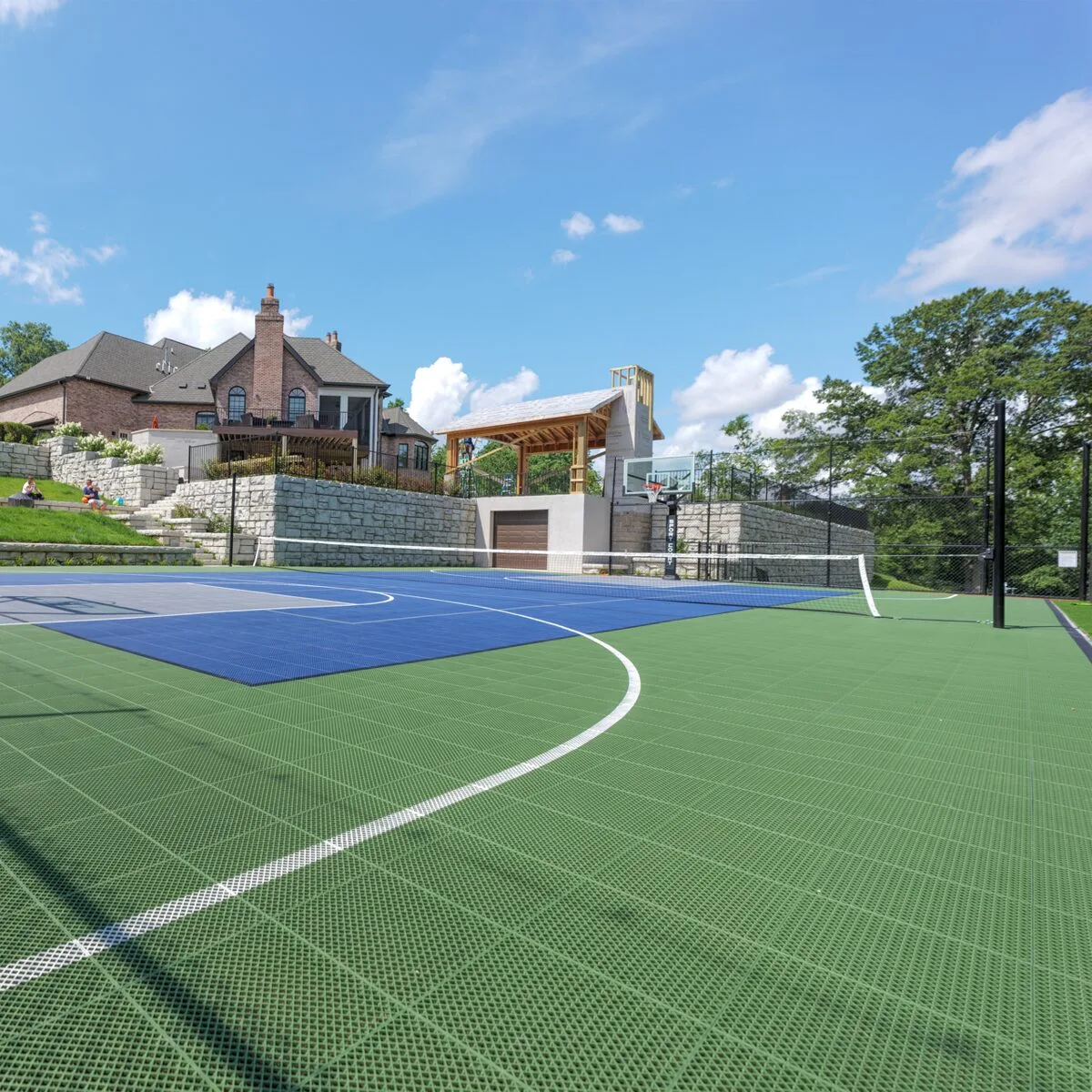
One court can incorporate game lines and equipment for basketball, pickleball, volleyball, tennis, and other activities, giving families the ability to do more within the same footprint.
That means you don’t necessarily have to choose between a backyard basketball court and a backyard pickleball court.
The same space can do both—and much more.
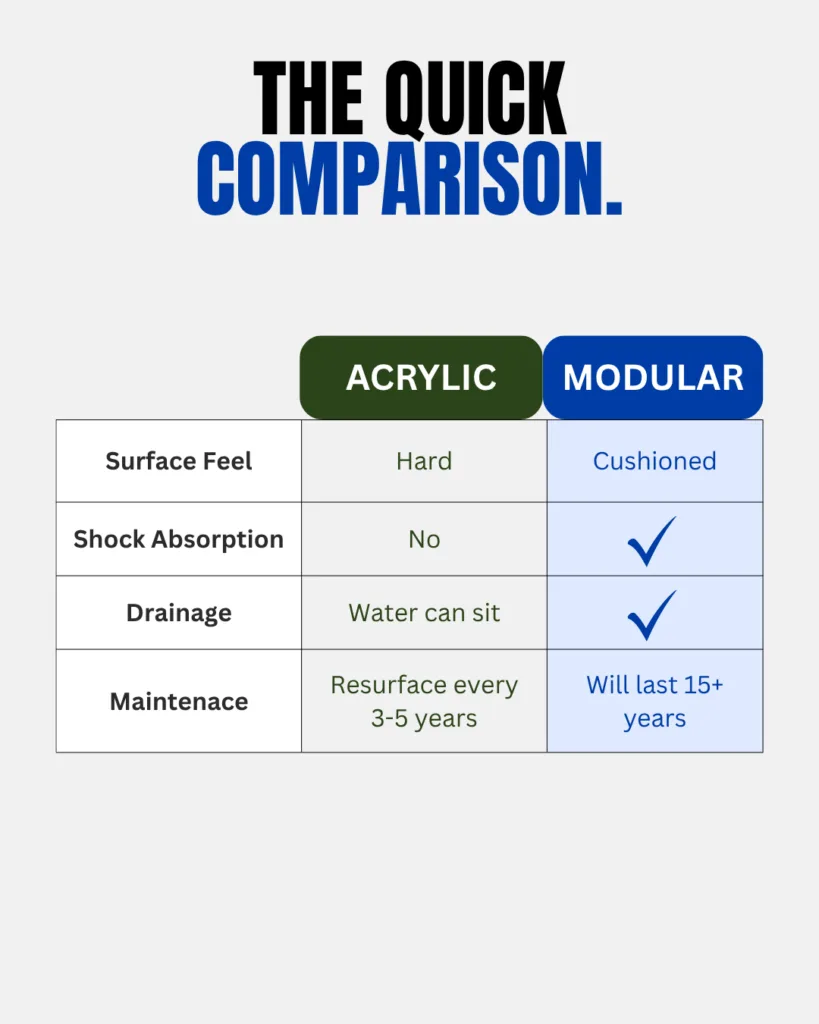
Which Court Surface Is Better: Acrylic or Modular?
Acrylic courts have long provided the familiar hard-court experience many players know.
For homeowners who want more than a traditional hard-court surface, however, a game court from Sport Court offers meaningful advantages in comfort, drainage, maintenance, customization, and versatility.
For many residential courts, a modular surface from Sport Court offers benefits that go beyond the traditional hard-court experience, including:
- Shock absorption and player comfort
- Efficient drainage after rain
- Lower surface-maintenance requirements
- Long-term durability
- Multi-sport versatility
- Extensive customization options
Those advantages become particularly important when you’re creating a space that isn’t just intended for one sport or one season, but for years of family play.